
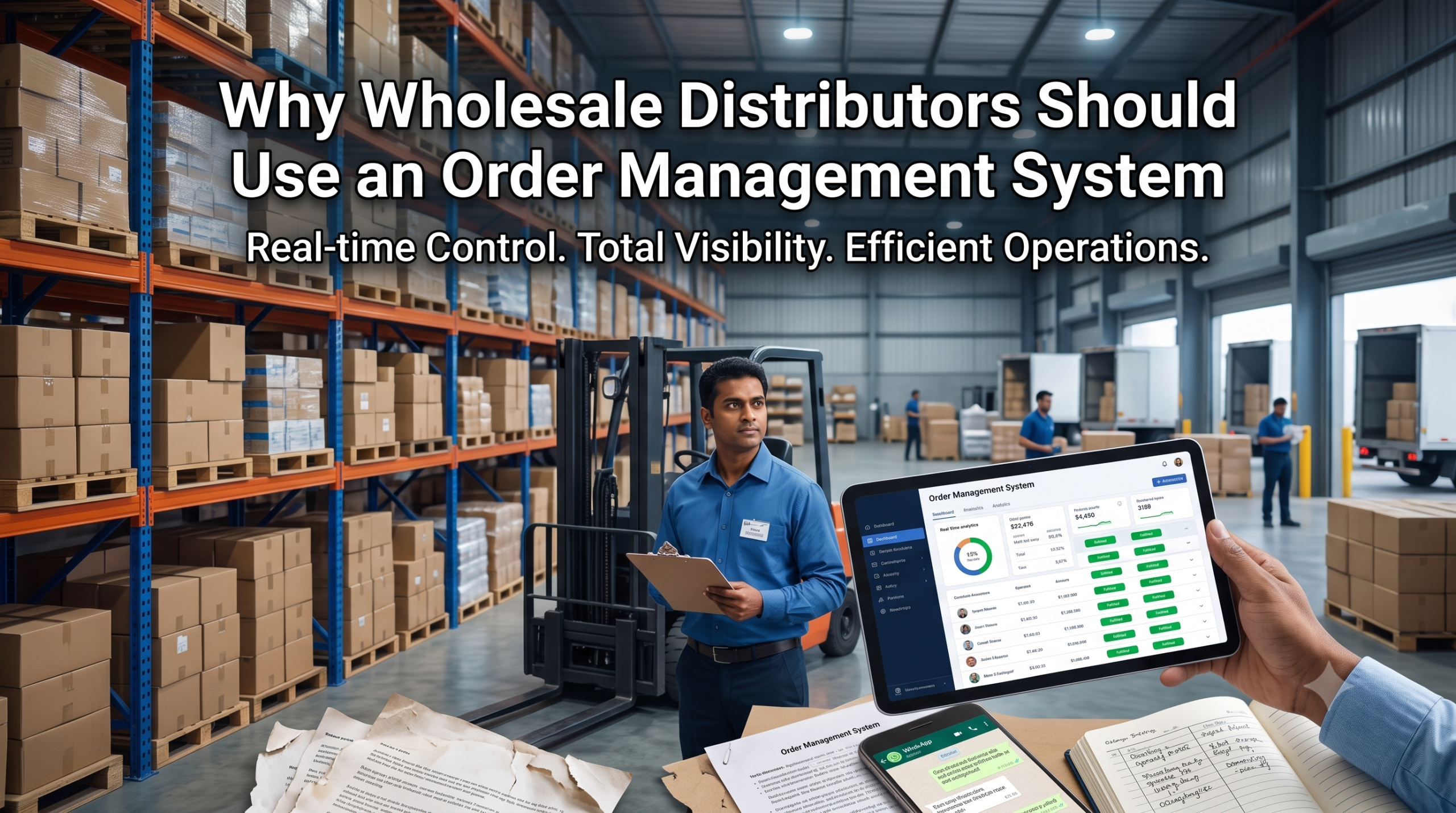
Ask any distributor how much stock they actually have of a fast-moving SKU right now, at this exact moment, and watch the pause before they answer. That pause — the gap between “I need to check with the warehouse” and an actual real-time number — is costing distribution businesses far more than most owners realize. It’s lost sales to competitors who quoted faster, it’s inventory tied up in the wrong warehouse, and it’s a sales team negotiating deals without knowing if the stock behind the deal even exists.
The Reality of Running a Distribution Business on Spreadsheets and WhatsApp
Most wholesale distribution businesses in India — even ones doing serious revenue — run their day-to-day order lifecycle across a patchwork of tools: Excel sheets for inventory, WhatsApp for order confirmations, phone calls for price negotiations, and a Tally entry that happens after the fact for accounting. It works, in the sense that orders do eventually get fulfilled. But it works despite the system, not because of it.
The costs of this approach rarely show up as one dramatic failure. They show up as a hundred small leaks
- A sales rep quotes a price that doesn’t reflect the latest negotiated rate for that specific client, because the last negotiation lived in a WhatsApp thread nobody cross-checked.
- Inventory numbers are updated once a day (or once a week), so orders get confirmed against stock that’s already been allocated elsewhere.
- Dispatch delays happen because nobody has a single view of which orders are ready, which are pending payment clearance, and which are waiting on vendor purchase.
- Payment follow-ups get missed because there’s no system flagging overdue accounts — someone has to remember to check.
What an Order Management System Actually Fixes
A proper distribution-focused Order Management System (OMS) isn’t just digital record-keeping. Done right, it connects every stage of the order lifecycle into one continuous, visible flow:
Lead and inquiry management — every incoming inquiry, whether from a call, WhatsApp, or a field sales visit, gets logged and tracked rather than living in someone’s personal notebook or memory.
Quotation with negotiation history — every price revision, discount, and counter-offer is recorded against the client and product, so a sales rep six months from now can see exactly how a client’s pricing evolved, instead of starting every negotiation from scratch or, worse, undercutting a previously agreed rate by accident.
Real-time inventory visibility — stock levels update the moment an order is confirmed or dispatched, across all warehouse locations, so sales teams are quoting against actual availability, not yesterday’s number.
Vendor and purchase order management — when stock runs low, purchase requirements against OEMs and vendors are visible immediately, rather than being discovered only when a customer order can’t be fulfilled.
Dispatch tracking — a single view of what’s packed, what’s out for delivery, and what’s delayed, replacing the daily ritual of someone physically walking the warehouse floor to check status.
Payment monitoring — outstanding dues, credit limits, and overdue accounts are flagged automatically, instead of relying on the accounts team to manually cross-reference invoices against bank statements.
Dashboard analytics — ownership finally gets a real-time view of sales performance, inventory turnover, and cash flow exposure, instead of waiting for a monthly reconciliation to understand how the business actually performed.
A Realistic Illustration
Picture a distributor handling a well-known consumer brand across a regional territory, running three warehouses and a sales team of about fifteen field reps. Before adopting a structured OMS, order confirmation-to-dispatch commonly took two to three days — not because fulfillment itself was slow, but because confirming actual stock availability across three warehouses required phone calls between the sales rep, the warehouse in-charge, and sometimes the accounts team to check if a client’s credit limit allowed the order to go through at all. After moving to a connected order management system with real-time inventory and automated credit-limit checks, that same confirmation-to-dispatch window dropped to same-day in most cases — not through any single big change, but because the information that used to require three phone calls was now visible to the sales rep on their own screen, instantly.
Why This Matters More as Distribution Businesses Scale
The spreadsheet-and-WhatsApp model tends to survive at small scale — a handful of SKUs, one warehouse, a sales team you can fit around one table. It breaks down predictably as distributors add warehouses, SKUs, and sales territories, because the coordination overhead grows faster than the business does. What was manageable friction at ₹5 crore in annual turnover becomes a genuine bottleneck at ₹50 crore, where the same manual coordination now has to happen across dozens of people and multiple locations simultaneously.
There’s also a competitive angle that’s easy to underestimate. Brand principals — the manufacturers whose products distributors carry — increasingly expect real-time sales and inventory reporting from their distribution partners as a condition of continued or expanded territory rights. A distributor who can produce clean, real-time dashboards on demand is simply easier for a principal to trust with more territory or a bigger product line than one still reconciling numbers manually every quarter.
What to Actually Look for in an OMS
Not every OMS in the market is built with distribution-specific workflows in mind — many are generic inventory tools retrofitted for distribution use. Worth checking for:
- WhatsApp and email integration, since most distributor communication with both sales staff and clients still happens over these channels rather than a dedicated portal.
- Role-based access, so a warehouse manager, a sales rep, and an accounts team member each see only what’s relevant to their function.
- Cloud/SaaS deployment, so multi-location visibility doesn’t depend on a single server sitting in one office.
- Genuine negotiation and quotation version control — not just a static price list, but a history of how pricing evolved per client.
The Hidden Cost of Delayed Payment Visibility
Payment monitoring deserves a bit more attention than it usually gets in these conversations, because cash flow — not sales volume — is what actually determines whether a distribution business survives a rough quarter. Without systematic tracking, overdue accounts tend to surface only when they become genuinely serious — a client quietly falling three months behind, discovered only when the accounts team happens to run a manual reconciliation. A proper OMS flags aging receivables automatically, well before they become a serious collections problem, and can tie credit limits directly to order approval, preventing a sales rep from unknowingly extending further credit to a client who’s already overdue. This single feature alone often justifies the cost of an OMS for distributors carrying meaningful receivables exposure across a large client base.
Choosing Between Building In-House and Buying a Ready Platform
Some larger distributors consider building their own order management tool in-house rather than adopting an existing platform. This can make sense if the business has genuinely unique workflows and in-house technical capacity to maintain the system long-term — but for most distribution businesses, the ongoing cost of maintaining custom software (bug fixes, feature updates, security patches) ends up higher than expected, and a customizable existing platform built specifically for distribution workflows, rather than a generic in-house build, tends to deliver a faster and more reliable return.
Final Word
The distribution business model hasn’t fundamentally changed — buy, store, sell, deliver, collect. What’s changed is how much coordination that model now requires across warehouses, SKUs, and sales territories that have grown faster than manual processes can keep up with. An Order Management System doesn’t replace the fundamentals of distribution; it just removes the friction of coordinating them by hand.
Running a distribution business and still coordinating orders across spreadsheets and WhatsApp threads? LAAYN OMS is a seven-module order management platform built specifically for distributors — covering lead management, quotations, inventory, vendor and purchase tracking, dispatch, payment monitoring, and dashboard analytics, with WhatsApp and email integration built in. Get in touch for a walkthrough of how it fits your current operations.
Learn more about LAAYN’s Order Management System, or contact our team for a demo.