
Walk into most public toilets in India and you’ll notice a pattern: they’re either reasonably clean because someone happened to check recently, or they’re in a state nobody would want to describe, because nobody checked in days. There’s rarely a middle ground built on consistent, verifiable maintenance. That inconsistency is the actual public health and dignity problem — not the absence of toilets, but the absence of accountability for keeping the ones that exist usable.
Why This Isn’t a Small Issue
Public and community toilets under Swachh Bharat Mission and various municipal schemes serve some of the most vulnerable populations — daily wage workers, street vendors, women without access to private sanitation, and slum communities where household toilets remain unaffordable or unavailable. When these facilities are poorly maintained, the fallout isn’t hypothetical:
– Women and girls avoid using unsafe or filthy facilities, which has documented links to health issues and, in some cases, safety risks from delaying use until facilities are more private (like after dark).
– Poor maintenance directly undermines Open Defecation Free (ODF) status, which many cities have officially claimed but struggle to sustain in practice.
– Disease transmission risk rises sharply in toilets without regular cleaning and water supply — something municipal health departments deal with every monsoon season.
The core issue is rarely that maintenance staff don’t exist. It’s that there’s no reliable way to know if cleaning actually happened, how often, and to what standard — until a citizen complaint or an inspection surfaces the problem, usually after it’s already bad.
Enter QR Code-Based Monitoring
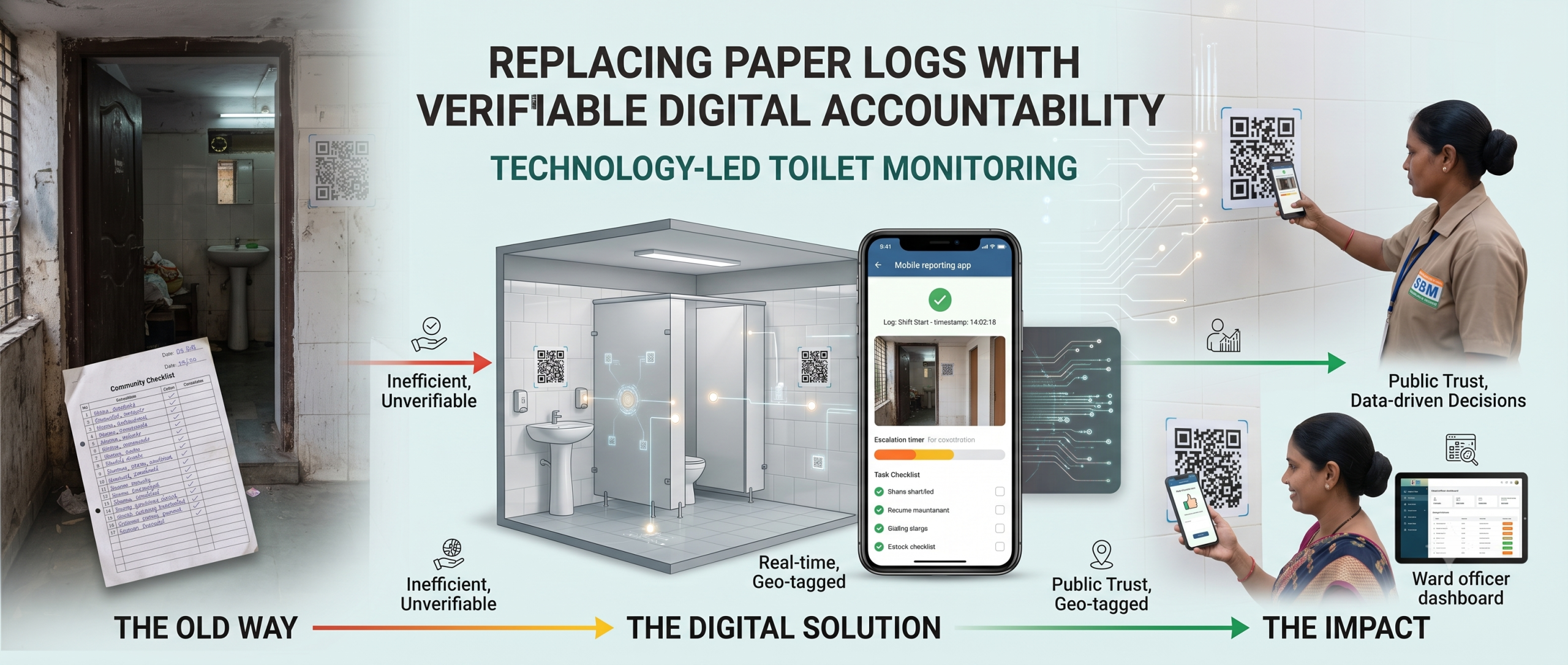
This is where the technology conversation has genuinely moved forward in the last two to three years. A QR code sticker placed inside each toilet — at the entrance, near the wash basin, wherever it’s visible — does two things simultaneously:
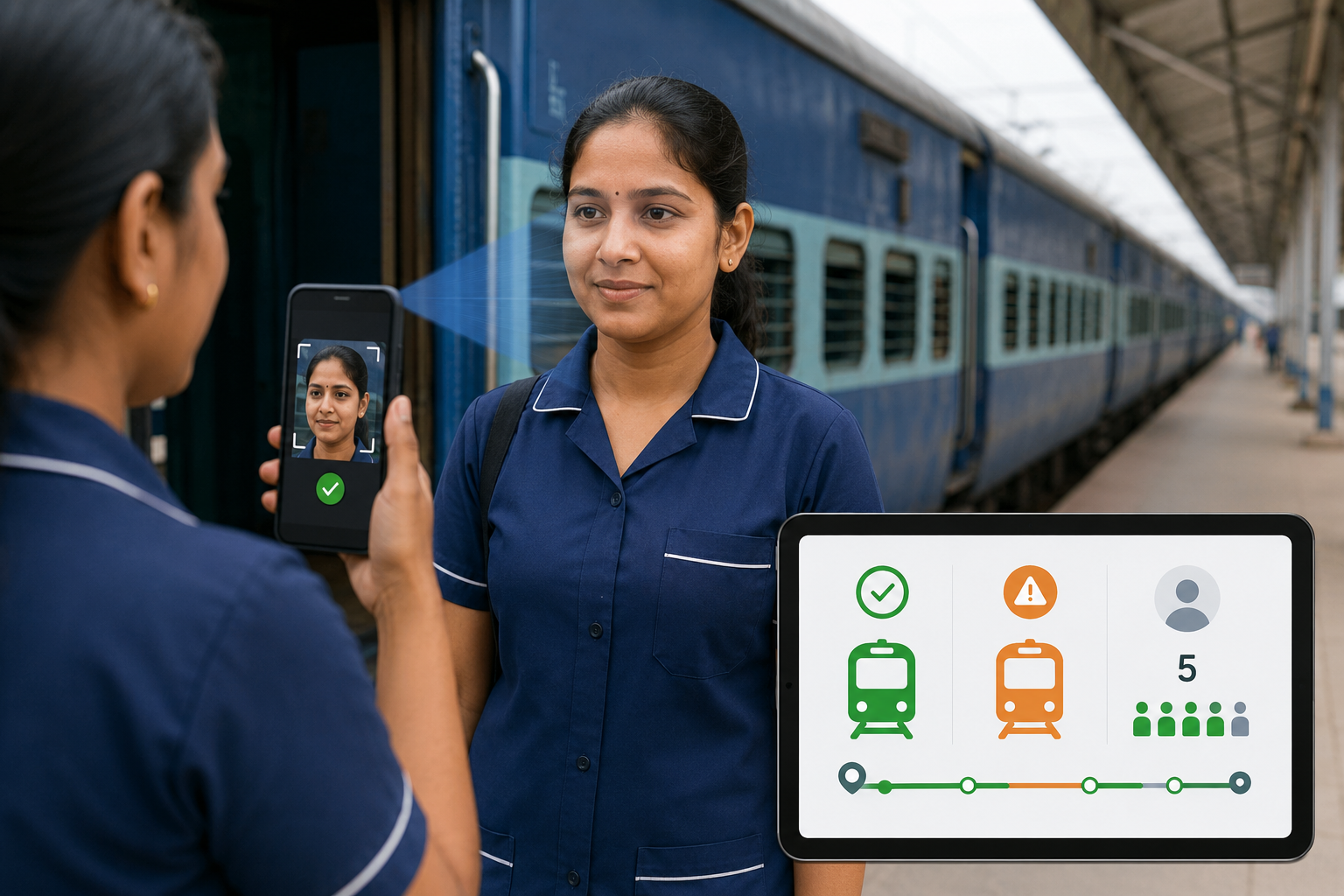
For the sanitation worker: Scanning the code at the start and end of a cleaning shift creates a timestamped, geo-tagged log. No more relying on a paper register that gets filled out all at once at the end of the day (a practice that, if we’re honest, happens far more often than anyone likes to admit).
For the citizen: The same QR code, scanned by any user, opens a simple feedback form — “Was this toilet clean? Rate it. Report an issue.” This turns every visitor into an informal auditor, and it costs the municipality nothing beyond printing a sticker.
The data from both sides feeds into a single dashboard that ward officers and municipal commissioners can review — which toilets are being cleaned on schedule, which ones are getting negative citizen feedback repeatedly, and which specific complaints (no water, broken door, foul smell) are recurring at which locations.
Mobile Reporting Apps: Closing the Loop
QR codes solve the “logging” problem. Mobile apps solve the “escalation” problem. A well-designed public toilet monitoring app typically does a few things well:
1. Real-time complaint registration with photo evidence, so a citizen doesn’t need to know who to call — they just open the app, snap a photo, and the complaint routes automatically to the right contractor or ward office.
2. Automated escalation timers — if a complaint isn’t resolved within a defined SLA (say, 4 hours for a cleanliness issue, 24 hours for a repair), it auto-escalates to a supervisor.
3. Cleaning schedule compliance tracking — cross-referencing QR scan logs against the mandated cleaning frequency (often 3-4 times a day for high-footfall toilets).
4. Analytics for procurement decisions — data showing which toilets have chronic issues (water supply, structural damage) helps municipalities prioritize capital repair budgets instead of just operational cleaning contracts.
A Small Example of What Changes
Consider a cluster of community toilets in a mid-sized municipal ward that had a long-standing reputation for being unusable by evening. Complaints existed, but they went through word-of-mouth to a councillor’s office, and by the time anything happened, the issue had often resolved itself (or gotten worse) on its own. After QR-based check-in monitoring and a citizen feedback app were introduced, the ward office could see, within the first month, that two of the five toilets accounted for the overwhelming majority of negative feedback — both had water supply issues, not cleaning issues. That reframing mattered: the contractor had been penalized repeatedly for “poor cleaning” when the actual root cause was infrastructure, not effort. Once the water supply was fixed, feedback scores on those two toilets improved sharply within weeks. The technology didn’t clean the toilets — it correctly diagnosed why they weren’t staying clean, which is arguably more valuable.
Why Societies (Not Just Municipalities) Should Care Too
This isn’t only a government infrastructure conversation. Residential societies, corporate campuses, malls, and transport hubs running their own public or shared toilets face an identical version of this problem at smaller scale — facilities managers assuming cleaning is happening because a vendor contract says so, with no independent verification. The same QR-check-in-plus-feedback-loop model applies directly to Facility Management (FM) contracts in private and semi-public spaces, and increasingly, RWAs and commercial FM companies are adopting it for the same reason municipalities are: it converts a trust-based vendor relationship into a data-based one.
The Honest Caveats
QR-based systems only work if citizens actually scan and report — adoption requires visible signage, some public awareness push, and ideally an incentive (some cities have experimented with small recognition or point systems for frequent reporters). And on the worker side, a QR scan proves presence at a location, not necessarily the quality of cleaning — it needs to be paired with periodic physical audits and, where feasible, photo-based proof-of-work uploaded at each scan.
The Gender and Safety Dimension Deserves Its Own Mention
It’s worth being specific rather than vague about who benefits most from reliable public toilet monitoring. Women and girls disproportionately bear the cost of unreliable, unsafe, or unhygienic public sanitation — whether that’s restricting fluid intake to avoid needing a facility during the day, avoiding facilities after dark due to safety concerns around poor lighting or isolated locations, or health consequences from delaying use altogether. Monitoring systems that track not just cleanliness but also functioning lighting, working locks, and adequate water supply directly address safety concerns that go beyond hygiene alone. Some municipal deployments have started layering in a “safety rating” alongside the standard cleanliness rating for exactly this reason — a toilet can be clean and still feel unsafe to use.
What a Rollout Actually Requires
Getting QR-based monitoring to actually work at scale isn’t just a matter of printing stickers. It requires a few things done properly: clear signage explaining what the QR code does and why scanning it matters (most citizens will ignore an unexplained sticker), a genuinely simple feedback form that takes ten seconds to fill rather than a lengthy survey nobody will complete, and — critically — visible follow-through, where citizens can actually see that their feedback led to a response. A feedback system that citizens perceive as a black hole, where complaints go in and nothing visibly happens, loses public participation quickly, regardless of how good the backend dashboard looks to municipal staff.
Final Word
Toilets are one of those pieces of public infrastructure where the gap between “built” and “usable” is entirely about ongoing accountability. QR codes and mobile reporting apps don’t replace sanitation workers or municipal will — they give both citizens and administrators the visibility to know, in real time, whether facilities are actually being maintained, and why they aren’t, when they’re not. That shift — from assumption to evidence — is what actually protects public health and dignity at scale.
Want to bring QR-based cleaning verification and citizen feedback monitoring to your municipality, township, or commercial facility? LAAYN Technologies builds customizable sanitation and facility monitoring solutions that integrate QR check-ins, mobile reporting, and real-time dashboards for ULBs and private facility managers alike. Reach out to discuss a pilot for your public toilet or FM contract.
Learn more about LAAYN’s Community & Public Toilet Monitoring System, or contact our team for a demo.