
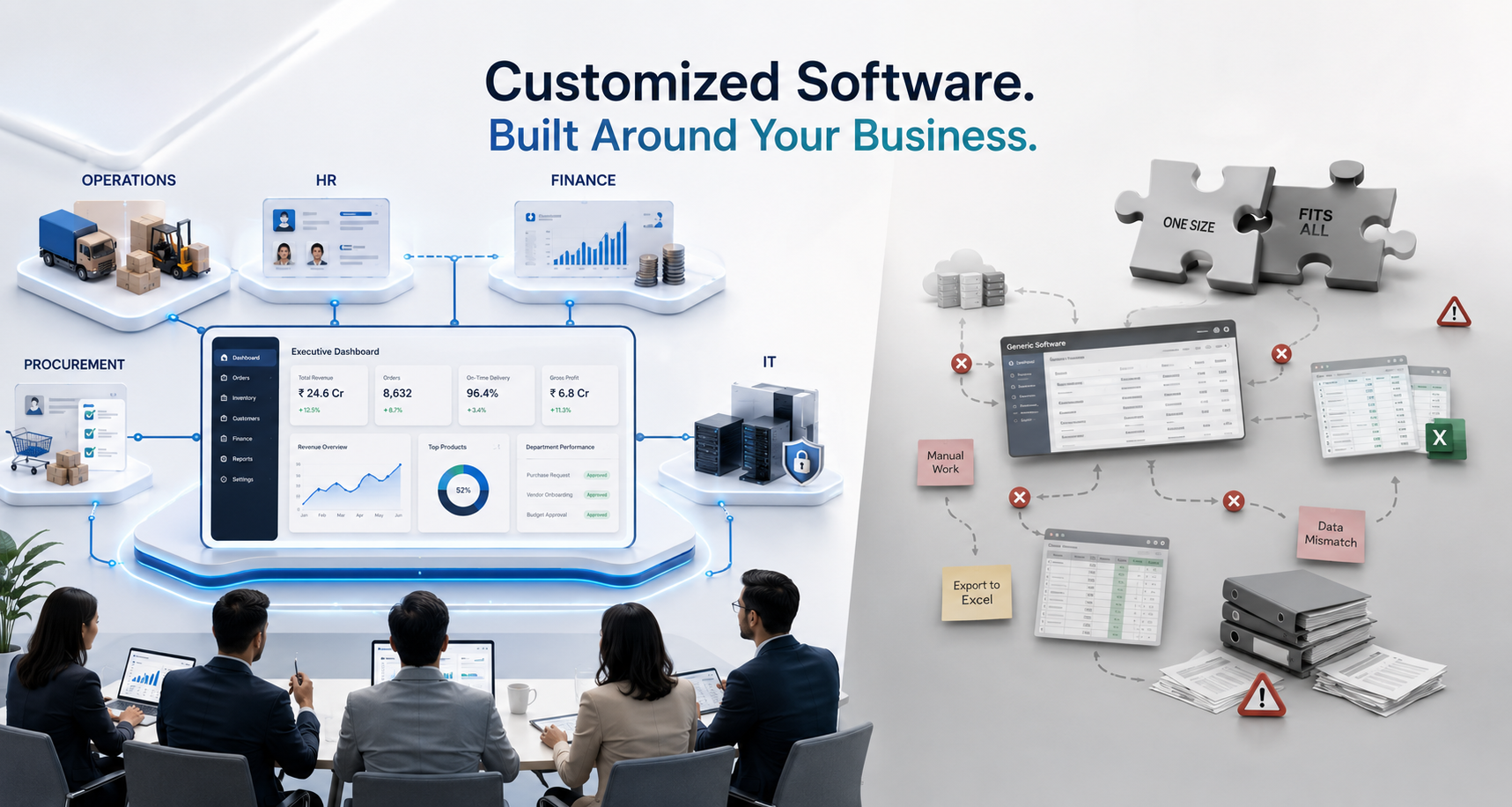
Every large organization that’s bought an off-the-shelf software product has, at some point, hit the same wall: the product does eighty percent of what’s needed cleanly, and then the remaining twenty percent — the part that actually reflects how your organization uniquely operates — requires either an expensive workaround, a change in your own process to fit the software, or simply living with the gap. For a small business, that eighty percent might genuinely be enough. For a large organization with established processes, regulatory obligations, and multiple stakeholders, that remaining twenty percent is usually where the real operational cost lives.
Readymade Software Is Built for the Average Customer — Not Yours
This is the honest starting point. Off-the-shelf products are designed to serve the widest possible customer base, which means their workflows are built around generalized assumptions about how a “typical” organization in your industry operates. For smaller businesses without deeply established processes, this is often fine — it’s even helpful, because the software’s assumptions become the process.
Large organizations, by contrast, almost always have existing processes shaped by years of operational history, industry-specific compliance requirements, organizational hierarchy, and integration needs with other internal systems. A readymade product wasn’t built with your specific approval chain, your specific reporting structure, or your specific regulatory obligations in mind — because it can’t be, since it’s selling the same product to hundreds of other organizations with different needs.
Where the Gap Actually Shows Up
Workflow mismatch. Off-the-shelf tools typically offer configuration options, not true customization — you can change settings within the boundaries the vendor designed, but you can’t fundamentally alter a workflow that doesn’t match how your organization actually operates. Large organizations end up bending their own established processes to fit software limitations, which creates internal friction and adoption resistance from teams who now have to work around the tool rather than through it.
Integration constraints. Big organizations rarely run one isolated system — they run an ecosystem of ERP, CRM, HR, and finance tools that need to talk to each other. Readymade products offer integration only through whatever APIs or connectors the vendor has chosen to build, which may or may not cover your specific stack. Custom software is built with your actual integration requirements as a starting design constraint, not an afterthought.
Scaling limitations. Many off-the-shelf products are priced and architected for a certain scale band, and organizations that grow beyond that band often discover performance issues, per-user cost structures that become punishing at scale, or feature limitations that only become visible once usage volume increases significantly.
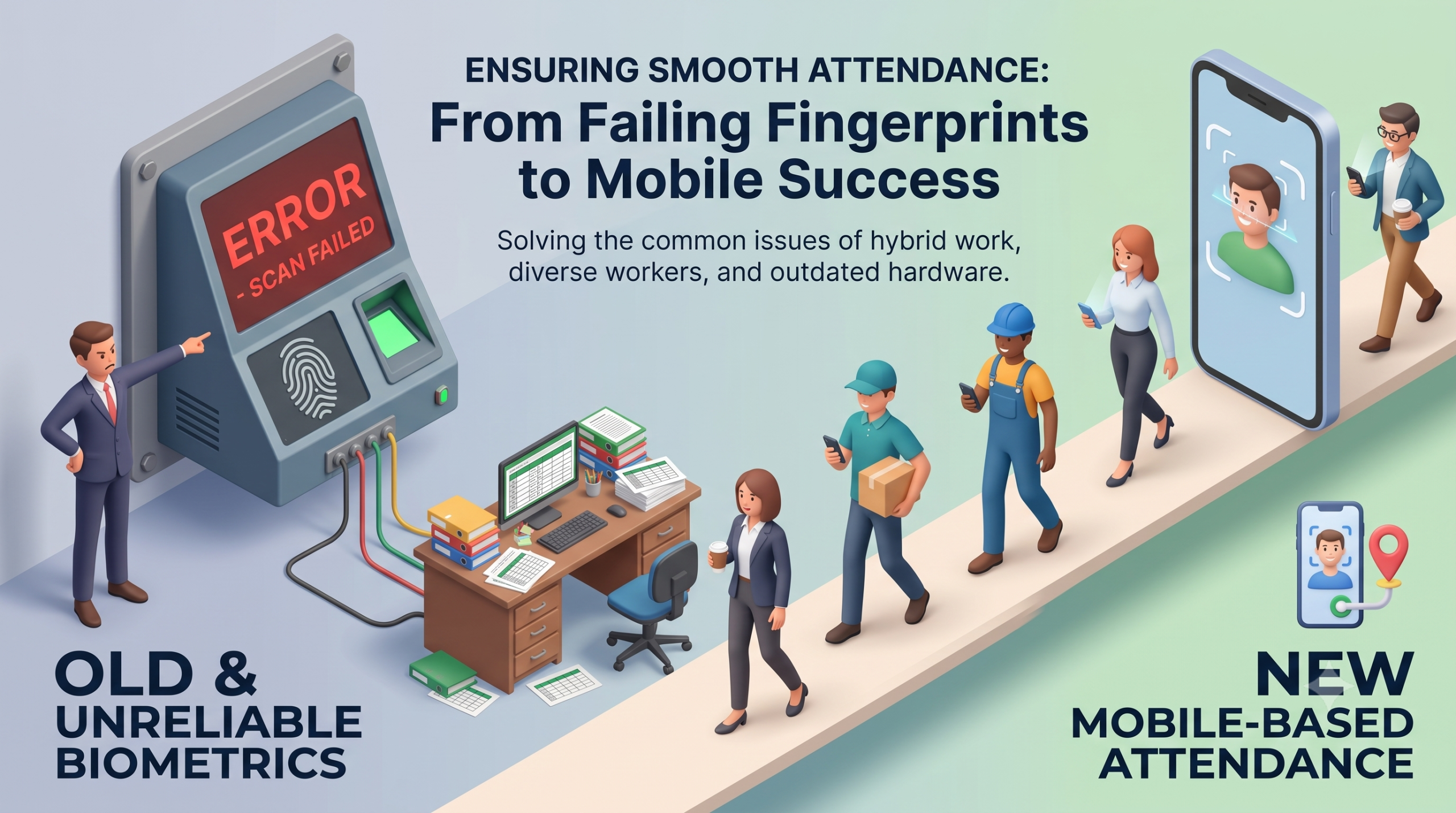
Compliance and data residency requirements. Large organizations, particularly in regulated sectors or those handling sensitive data (biometric attendance systems under the DPDP Act, for instance), often have specific data handling, storage, and audit requirements that generic products weren’t built to satisfy out of the box, if at all.
Vendor dependency and roadmap misalignment. With readymade software, your organization’s specific needs compete for the vendor’s development attention against every other customer’s needs. A feature critical to your operations might sit on the vendor’s backlog indefinitely if it doesn’t align with their broader product roadmap or majority customer base.
Where Readymade Software Genuinely Makes Sense
It’s worth being fair here rather than one-sided: for standardized, non-differentiating functions — generic email, basic accounting for a small business, simple project tracking — readymade software is usually the right call. Building custom software for a function where your organization has no unique process or competitive need is a waste of development resources. The case for customization gets stronger specifically when:
- The function in question is core to how your organization actually operates or competes (not a generic back-office task).
- You have complex, multi-stakeholder workflows that don’t map cleanly onto a generic tool.
- Integration with existing systems is critical, not optional.
- Regulatory or data handling requirements are specific to your industry or region.
- The organization is large enough that per-user licensing costs of readymade enterprise software become substantial over time, at which point custom development often becomes the more cost-effective long-term option, not just the better-fit one.
A Grounded Illustration
Consider a large distribution business that initially adopted a well-known generic inventory and order management SaaS product, chosen mainly because it was quick to deploy and widely used in the market. Within the first year, the operations team found themselves manually exporting data into spreadsheets every week to reconcile the specific vendor negotiation and multi-warehouse dispatch workflows the business actually ran — workflows the generic product simply hadn’t been built to handle, because it was designed around a more generic, single-warehouse retail model. The software wasn’t badly built; it just wasn’t built for this business’s specific operating model. After moving to a customized order management platform built around the company’s actual negotiation, multi-warehouse, and vendor workflows, that weekly manual reconciliation effort disappeared — not because the new software was inherently more powerful, but because it was designed around the business’s real process instead of asking the business to adapt to a generic one.
The Honest Trade-offs of Going Custom
Custom software isn’t automatically the right answer for everyone, and it’s worth being upfront about the trade-offs. It typically costs more upfront than a readymade subscription, takes longer to build and deploy than simply signing up for an existing SaaS product, and requires a more involved discovery process to properly capture requirements. For organizations without clearly defined, differentiated processes, that upfront investment may not pay off relative to just using an established product.
The decision, ultimately, comes down to a fairly simple question: is this software function something that reflects how your organization is genuinely different from its competitors, or is it a generic utility that every organization needs in roughly the same way? The former justifies customization. The latter usually doesn’t.
The Middle Path: Customizable Platforms Instead of Fully Bespoke Builds
It’s worth noting that “custom software” doesn’t always mean building something entirely from scratch, which is the most expensive and time-consuming version of customization. A middle path that works well for many large organizations is adopting a platform that’s purpose-built for their industry or function but designed with genuine configurability at its core — meaning the vendor-built flexibility into the architecture from day one, rather than bolting on limited settings after the fact to a rigid, generic product. This approach can deliver much of the fit and workflow alignment of a fully custom build, at a fraction of the cost and time, because the underlying platform already understands the domain (distribution, HR, infrastructure bidding) even before organization-specific customization begins.
How to Evaluate Whether You Actually Need Customization
Before committing to a custom build, it’s worth honestly mapping out where the organization’s processes genuinely diverge from industry-standard workflows versus where they simply feel unique but actually aren’t. A useful test: if three different competitors in your industry would describe this specific process in roughly the same way, it’s probably not a strong candidate for expensive customization — a good readymade or configurable product likely already handles it well. If your process reflects a genuinely specific competitive approach, regulatory requirement, or organizational structure that competitors don’t share, that’s where the investment in customization tends to pay off.
Final Word
For large organizations, the real cost of readymade software isn’t the subscription fee — it’s the years of accumulated workarounds, manual reconciliation, and process compromises made to accommodate a tool that was never built around how the organization actually operates. Customized software costs more to build, but it’s built around your business, not the other way around — and at scale, that difference compounds significantly.
Evaluating whether your organization’s core operations warrant a custom-built solution? LAAYN Technologies builds fully customized software — from order management to HR and attendance systems — designed around how your organization actually works, not a generic template. Get in touch to discuss your specific requirements.
Learn more about LAAYN’s custom software solutions, or contact our team for a demo.