
Every infrastructure consulting firm that’s been in the business long enough has a story about a bid that was lost not to a competitor’s better proposal, but to a missed deadline, a missing compliance document discovered the night before submission, or a checklist item nobody owned. These aren’t rare, dramatic failures — they’re a routine, quiet drain on win rates that most firms have simply learned to live with, because the alternative — tracking every RFP’s entire lifecycle by hand across spreadsheets and email threads — has never felt worth fixing.
The Bidding Process Has More Moving Parts Than Most Systems Account For
Government and infrastructure tenders in India — whether from ULBs, state PWDs, smart city SPVs, or central ministries — follow a lifecycle that looks deceptively linear on paper: tender notification, pre-bid queries, document preparation, EMD submission, technical and financial bid submission, evaluation, and award. In practice, each stage has enough sub-tasks and hard deadlines that manually tracking all of them across even a handful of simultaneous bids becomes genuinely difficult.
Compliance documents get missed, not because of negligence, but because of volume. A single infrastructure tender can require a dozen or more supporting documents — company registration, GST certificates, past experience certificates, audited financials, EMD instruments, power of attorney, technical certifications — each with its own validity period and format requirement. When a firm is tracking five or six live bids simultaneously, each with a different document checklist, it takes exactly one oversight — an expired certificate, a missing notarization — to get a bid technically disqualified before evaluation even begins.
Pre-bid query deadlines slip through because they’re easy to underestimate. Pre-bid meetings and query submission windows are often short and easy to deprioritize against the “real” submission deadline, which feels further away. But missing a pre-bid query window means losing the only formal opportunity to seek clarification or push back on unfavorable tender clauses — a mistake that can only be discovered, painfully, much later during evaluation.
Checklists exist on paper but nobody owns real-time tracking. Most firms do have bid checklists. The problem is rarely the checklist’s existence — it’s that checklists live in static documents, not systems that actively track completion status, flag what’s pending, and escalate as deadlines approach. A checklist in a Word document doesn’t send a warning three days before an EMD needs to be arranged.
Competitor intelligence is almost entirely informal. Very few mid-sized consulting firms have a systematic way of tracking which competitors bid on which tenders, at what price points, and with what technical approach. This information, when it exists at all, usually lives in individual employees’ memory or scattered notes — which means every new bid essentially starts its competitive strategy from scratch, rather than building on a growing institutional knowledge base of how competitors’ price and position themselves.
What a Proper RFP Management System Actually Does
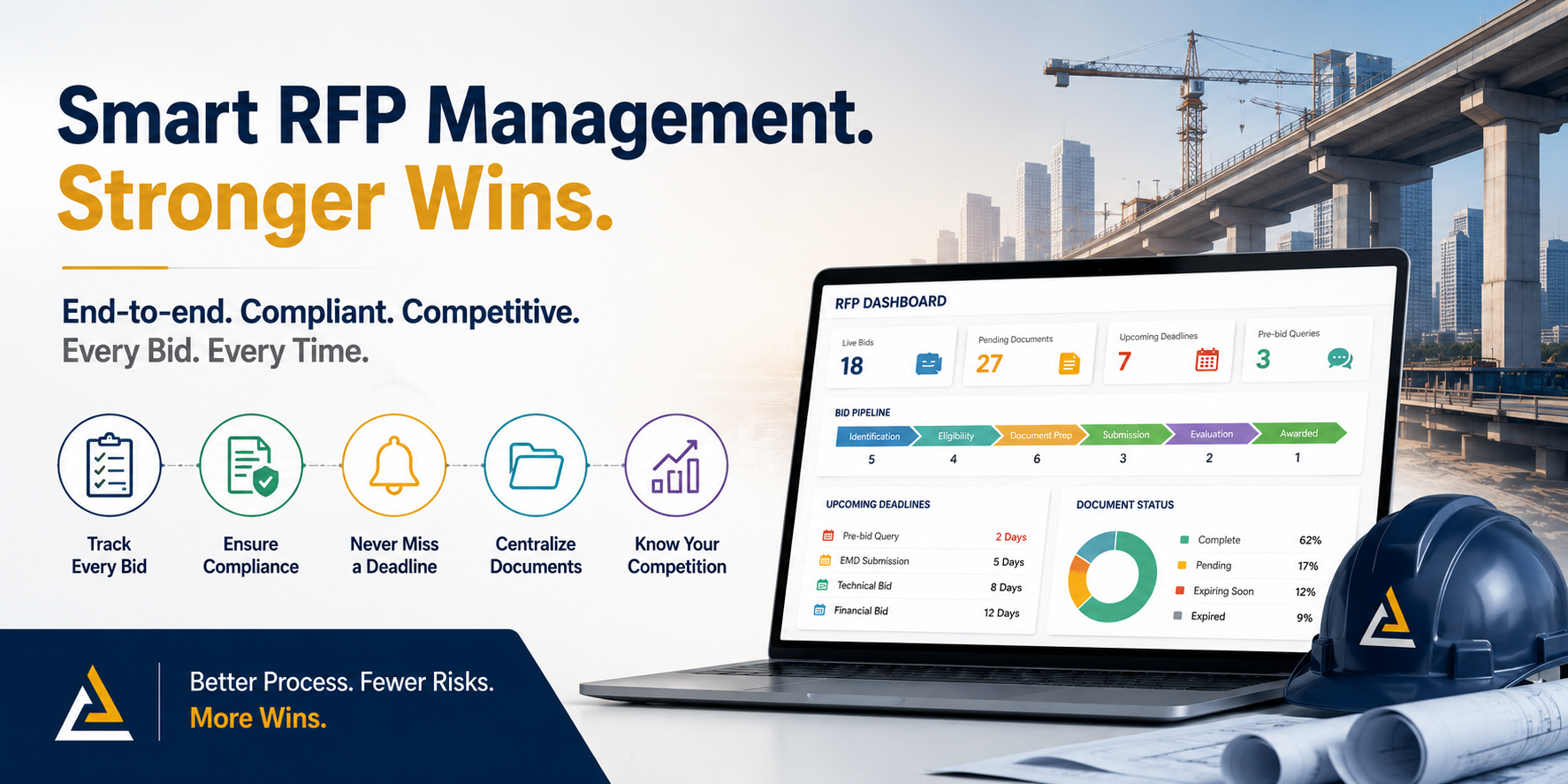
End-to-end lifecycle tracking — from tender identification and eligibility screening through to submission and post-award follow-up, with every stage visible in one place rather than scattered across email, WhatsApp, and individual laptops.
Automated compliance and document tracking — a live checklist tied to each specific tender’s requirements, with automated alerts for documents nearing expiry or still pending, so gaps surface weeks before a deadline rather than the night before.
Deadline and milestone alerts — pre-bid query windows, EMD submission dates, technical bid deadlines, and clarification response windows all tracked with automated reminders, rather than relying on someone manually maintaining a master calendar.
Centralized document repository — a single source of truth for reusable compliance documents (registration certificates, past experience letters, standard company profiles) that don’t need to be re-gathered from scratch for every new bid.
Competitor intelligence tracking — a structured record of which competitors have bid on similar tenders, at what technical and financial terms were publicly available, building institutional memory that improves pricing and positioning strategy over successive bids rather than starting cold each time.
DPR and technical document automation — for firms also handling Detailed Project Report (DPR) preparation, automating recurring sections and templates significantly cuts the manual drafting burden across similar infrastructure project types.
A Grounded Example
Consider a mid-sized infrastructure consulting firm that regularly bids on 15-20 tenders a year across multiple state PWDs and ULBs, historically tracking everything through a combination of shared spreadsheets and individual employees’ inboxes. On at least a couple of occasions in a typical year, a technically strong bid got disqualified purely on a compliance technicality — an EMD instrument submitted in the wrong format, or a past-experience certificate that had quietly expired between bids without anyone re-checking it. After adopting a structured RFP management system with automated compliance tracking, the firm’s own bid team could, for the first time, see every pending document requirement across all live bids on a single dashboard, well ahead of submission deadlines rather than discovering gaps under time pressure. The measurable change wasn’t necessarily more bids won on technical merit — it was fewer bids lost to entirely avoidable, non-technical disqualifications, which is arguably the more frustrating way to lose a tender in the first place.
Why This Matters More as Firms Scale
A firm bidding on two or three tenders a year can manage the process manually without much trouble — the coordination overhead is low enough that spreadsheets and diligence cover the gaps. Those stops being true once a firm is running 15, 20, or more simultaneous bid pursuits a year, often across different states with different documentation norms and different teams handling each bid. The manual approach doesn’t fail all at once — it fails intermittently, unpredictably, and expensively, exactly when a firm can least afford it (a large, high-value tender lost to an avoidable technicality).
The Honest Limitations
An RFP management system doesn’t write a winning technical proposal, and it doesn’t replace the judgment needed to price a bid competitively — it removes the operational risk of losing a bid for reasons that have nothing to do with the quality of the proposal itself. It’s also only as good as the discipline of the team using it; a system that flags a pending document is only useful if someone acts on the alert.
The Post-Award Lifecycle Gets Overlooked Too
Most conversations about RFP management focus entirely on winning the bid, but the lifecycle doesn’t end at award — and this is another area where firms without systematic tracking run into trouble. Post-award compliance obligations (progress reporting, milestone documentation, deliverable submissions against contracted timelines) carry their own deadlines and requirements, and firms that treat the RFP system as purely a pre-submission tool often revert back to manual tracking once a bid is won, losing the same visibility benefits exactly when ongoing contract compliance starts to matter for renewal or future bid eligibility with the same client. A properly used RFP management system tracks the full lifecycle — pre-bid through post-award delivery — not just the submission phase.
Building Institutional Memory Instead of Starting Over Each Time
Perhaps the most underrated benefit of a structured RFP system is what it does over multiple bid cycles rather than on any single tender. Firms that rely on individual employees’ memory and personal files for bid intelligence lose that knowledge whenever a key employee leaves or moves teams — years of accumulated experience about specific clients, tender patterns, and competitor behavior walk out the door with them. A centralized system captures this institutional knowledge independent of any one person, meaning a new team member picking up a bid for a familiar client or region has access to the same historical context a five-year veteran would carry in their head. Over time, this compounding institutional memory becomes a genuine competitive advantage that’s difficult for competitors without similar systems to replicate.
Final Word
Most infrastructure consulting firms don’t lose bids because their technical teams aren’t capable — they lose bids, more often than anyone likes to admit, to process failures that a properly structured system would have caught weeks in advance. An RFP management solution’s real value isn’t sophistication; it’s simply removing the avoidable losses from the process entirely.
Tired of losing bids to missed compliance documents or deadlines rather than technical merit? LAAYN’s RFP Management System is built specifically for infrastructure consulting firms handling multiple simultaneous tenders, with automated compliance tracking, deadline alerts, and DPR automation. Get in touch to see how it fits your current bidding workflow.
Learn more about LAAYN’s RFP Management System, or contact our team for a demo.