
On-Board Housekeeping Services (OBHS) contracts run on a workforce structure that makes traditional attendance systems almost useless by design: staff work on moving trains, across routes that span hundreds of kilometers, with shifts that start and end at different stations entirely. There is no fixed office gate to install a biometric machine at, no single location where a supervisor can visually confirm who showed up. And yet OBHS vendors are contractually accountable to Indian Railways for exactly that — verified, deployed staff, per train, per route, per shift.
Why OBHS Attendance Is a Structurally Different Problem
Most workforce attendance challenges — even distributed, multi-site ones — eventually settle around some kind of fixed location a worker report to. OBHS staff don’t have that. A housekeeping team assigned to a long-distance train board at the originating station and works through to the destination, sometimes over 15-20 hours or more, with no fixed checkpoint in between where attendance could conventionally be verified.
This creates a genuine accountability gap that vendors have historically managed through manual coordinator sign-offs and paper-based duty rosters — systems that are difficult to independently verify and easy, whether intentionally or through simple administrative error, to get wrong. For Indian Railways, which pays OBHS vendors based on verified staff deployment against contracted service levels, this gap has real financial and service-quality consequences: if attendance can’t be reliably confirmed, neither can actual service delivery on board.
Where Facial Recognition Attendance Fits This Specific Use Case
The core requirement for OBHS attendance isn’t complicated in concept — confirm that the specific, registered staff member is present and boarded for their assigned train and shift, at the point of boarding, without requiring fixed infrastructure at every possible boarding station across the country.
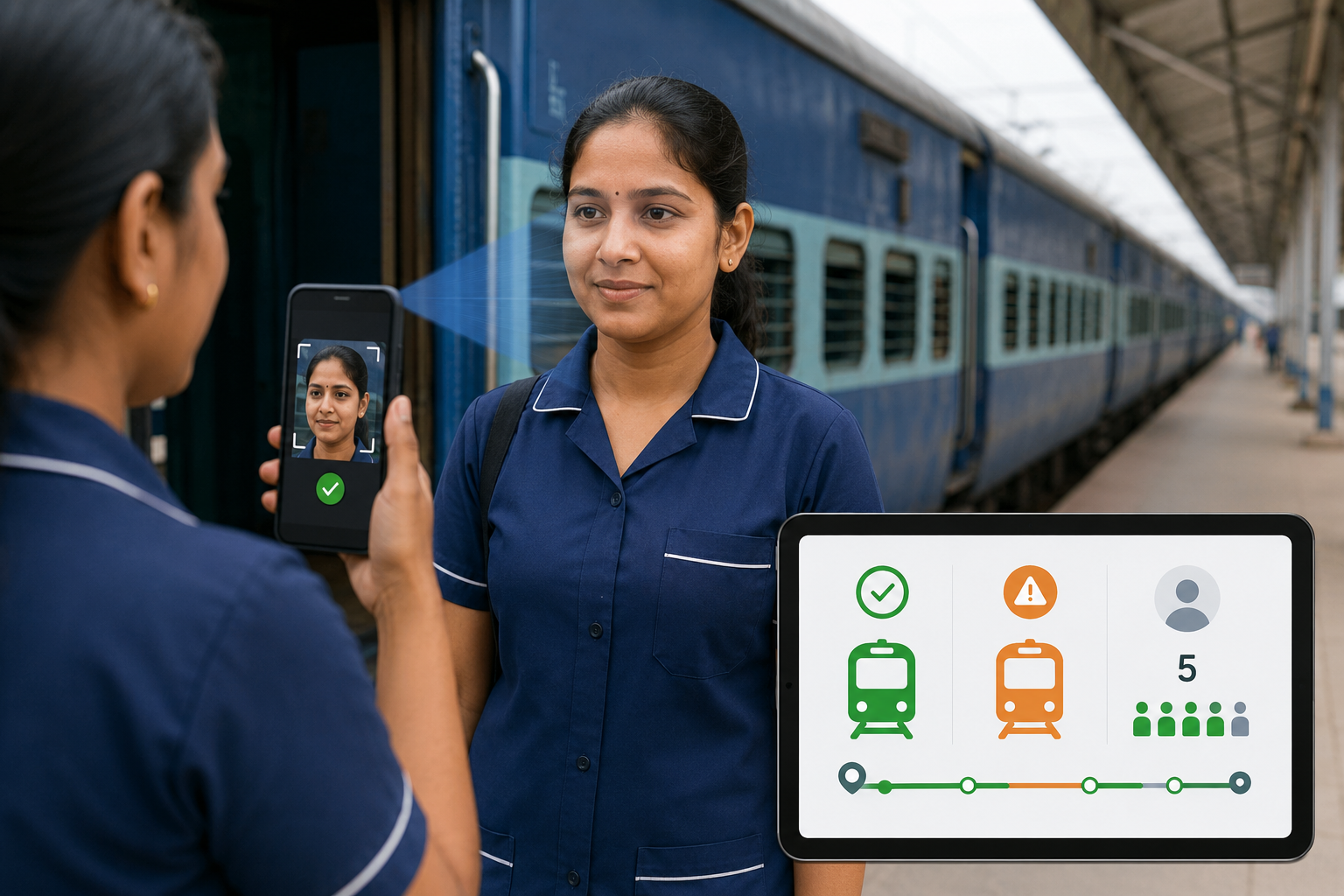
A mobile-based facial recognition attendance system addresses this directly
Mobile-first, not location-fixed. Since verification happens through a mobile device rather than a wall-mounted machine, staff can be verified at any boarding point — a major station, a smaller originating point, wherever the assigned shift begins — without requiring dedicated hardware installed at every possible location across the rail network.
Identity verification at the point of deployment. Facial recognition confirms the specific registered worker is the one actually boarding, addressing a known industry concern around substitute deployment — where a registered staff member doesn’t personally show up and sends an unregistered substitute in their place, which creates both a service-quality and a security concern for a public transport operator.
Shift and route-specific logging. Attendance is logged against the specific train, route, and shift assignment, rather than a generic “present/absent” mark, giving vendors and Railways alike much more granular data than a traditional register could provide.
Coordinator dashboard visibility. OBHS coordinators and vendor management get real-time visibility into which trains have confirmed, verified staff deployment and which don’t — turning what used to be a reactive, complaint-driven process (a passenger complaint about missing housekeeping staff being the first sign something went wrong) into a proactive one where gaps in deployment can be flagged before a train even departs.
Reporting for contractual compliance. Since OBHS contracts with Railways are performance and deployment-linked, vendors need clean, auditable attendance records to support billing and compliance reporting. A digital, facial recognition-based log is significantly more defensible in an audit than a manually filled paper roster.
What This Looked Like in Practice
For OBHS vendors managing housekeeping staff deployment across multiple train routes, the shift from manual coordinator-based attendance confirmation to mobile facial recognition attendance addressed a specific, recurring operational pain point: the gap between staff assigned on the duty roster and staff actually verified as boarded and working. Previously, this verification depended almost entirely on a coordinator’s manual confirmation, communicated up the chain informally, with no independent, timestamped, photo-verified record backing it. With facial recognition-based mobile attendance, vendors gained a verifiable, auditable log tied to the actual boarding event — which strengthened their own contractual compliance reporting to Railways and reduced disputes around deployment verification that had previously relied on word-of-mouth coordinator confirmation.
Why This Matters Beyond Just Compliance
There’s a service-quality dimension here that matters as much as the compliance angle. When Railways and the traveling public raise concerns about on-board cleanliness and housekeeping quality, one of the underlying, less-discussed causes is inconsistent staff deployment — verified, adequately staffed trains simply deliver more consistent service than trains where deployment gaps go unnoticed until a passenger complaint surfaces them. Reliable attendance verification isn’t just an administrative box to check for vendors — it’s a direct input into whether the service passengers actually experience matches what’s contracted.
The Honest Constraints of This Use Case
Mobile-based systems for a mobile workforce come with their own specific challenges that any vendor needs to plan for: network connectivity at various boarding points can be inconsistent, requiring offline-capable check-in with sync-on-connect functionality rather than assuming continuous connectivity. Staff turnover in OBHS contracts can also be relatively high, which means onboarding new staff into a facial recognition system needs to be a fast, low-friction process, not a bottleneck that delays deployment.
Why This Extends Beyond OBHS to Other Mobile Rail Workforces
The same underlying attendance challenge — a workforce that’s constantly moving, without a fixed reporting location — applies to other categories of on-board and station-adjacent rail staff beyond housekeeping alone, including catering staff, security personnel deployed across multiple trains, and station-level contract workers rotating across shifts and platforms. Vendors managing any of these workforce categories face a structurally identical problem to OBHS attendance: how to verify identity and deployment for staff who don’t report to one fixed location. A mobile facial recognition attendance platform built with this flexibility in mind can extend across these adjacent use cases without requiring an entirely separate system for each contract category, which matters for vendors managing multiple types of rail service contracts simultaneously.
What Vendors Should Look for When Evaluating a System
Not every mobile attendance vendor has actually built for the specific constraints of rail-based, mobile workforce deployment. Worth confirming before adoption: does the system handle offline check-ins gracefully when connectivity is poor at a boarding point, syncing once signal returns, rather than simply failing the check-in attempt? Can staff onboarding — capturing a new worker’s facial data into the system — happen quickly enough to keep pace with the turnover rates common in OBHS-type contracts? And does the reporting output map cleanly onto the specific compliance and billing documentation formats Railways and vendor management already expect, rather than requiring manual reformatting after the fact?
Final Word
OBHS attendance was never going to be solved by a better version of a fixed biometric machine, because the underlying workforce structure — mobile, multi-location, shift-based across a national rail network — simply doesn’t fit that model. Mobile facial recognition attendance fits the actual shape of the problem: verifying identity and deployment at the point of boarding, wherever that happens to be, with a data trail that holds up for both vendor compliance reporting and Railways’ own service-quality oversight.
Managing OBHS staff deployment across multiple train routes and need reliable, auditable attendance verification? LaaynHR by LAAYN Technologies has worked with OBHS vendors on mobile facial recognition-based attendance for on-board train staff, built specifically for distributed, non-fixed-location workforces. Get in touch to discuss how it can fit your current deployment and compliance workflow.
Learn more about LAAYN’s Railway Manpower Attendance Management System, or contact our team for a demo.